The Algorithmic Advantage: How Data First Brokerages Are Outperforming in the 2025 Market
In the complex ecosystem of modern real estate, a new determinant of success has emerged. This factor has little to do with traditional metrics like years of experience or personal charisma. The brokerages dominating today's market are those that have mastered a different language altogether. They speak the language of data. They have moved beyond simply using technology to becoming fundamentally algorithmic in their operations. These organizations do not just respond to the market. They predict it. They do not just manage clients. They model client behavior. They have transformed their brokerage from a service business into an intelligence operation that happens to close real estate transactions.
This shift represents a profound departure from the industry's relational roots. While relationships remain crucial, they are now systematically engineered, measured, and optimized at scale. The most valuable asset in these brokerages is not their agent roster or their office location. It is their proprietary data set and the algorithms that interpret it. They have built what tech strategists call a data moat. This is a competitive barrier created not by brand alone, but by superior information and the systems to act on it faster and more effectively than anyone else.
The End of Intuition Based Real Estate
For generations, real estate success was framed as an art form. Top producers spoke of gut feelings about neighborhoods. They talked about sensing the right offer price, and developing a knack for knowing what clients really wanted. While experience remains valuable, reliance on intuition alone has become a significant liability in today's data rich environment. The intuition based model suffers from three critical, interconnected flaws.
First, it is inherently unscalable. An agent's gut feeling is a personal, non transferable asset. It cannot be taught to a new team member with consistency. Nor can it be deployed across hundreds of simultaneous transactions. A brokerage built on individual intuition cannot grow predictably. It can only add more individuals, each with their own unpredictable and variable instincts.
Second, it is notoriously inconsistent. One agent's intuitive price recommendation might differ wildly from another's, even for identical properties. This creates a fractured and unreliable brand experience for consumers. These consumers increasingly expect evidence based decisions, not hunches, for the largest financial transaction of their lives.
Third, and most damningly, it is impossible to optimize. You cannot improve what you do not measure. When decisions are based on feeling, there is no feedback loop to determine if those feelings were correct. There is no way to know what patterns might lead to better outcomes. The business remains stagnant. It repeats the same processes without ever learning from them in a systematic way.
The algorithmic brokerage surgically addresses these flaws. It replaces guesswork with calculation, inconsistency with standardization, and stagnation with continuous, data driven learning.
The Core Algorithm: The Client Conversion Engine
At the heart of the algorithmic brokerage is its core conversion algorithm. This is not a single piece of software. It is an interconnected system of processes designed to maximize the probability of a successful transaction at every stage of the client journey. This system is powered by a platform like Keyvera, which provides the essential data streams and automated actions.
The algorithm begins with Predictive Lead Scoring and Engagement. When a new lead enters the system, it is not treated as a simple contact. It is immediately analyzed against thousands of historical data points. The lead could be from a Zillow inquiry, a Google ad click, or a website form. The system evaluates the lead's source, the specific property viewed, the time of engagement, the browsing history, and even the phrasing of their initial inquiry. In milliseconds, it assigns a predictive score. This score estimates the likelihood of conversion and determines the optimal engagement protocol.
This is where AI Speed to Lead transitions from a simple auto responder to an intelligent engagement specialist. The system does not just say hello. It delivers a response tailored to that lead's predicted profile. For a high intent, first time buyer who has viewed multiple listings in one school district, the AI might immediately provide a neighborhood market report and offer to schedule a buyer consultation. For a lower intent lead, it might engage in a longer qualifying dialogue. This ensures maximum efficiency. It directs the highest touch human resources to the opportunities with the greatest mathematical probability of closing.
The algorithm extends to Communication Routing and Timing. Using historical data on agent performance, the system does not just assign a lead to an available agent. It assigns it to the agent with the highest historical conversion rate for that specific lead type, price point, and neighborhood. Furthermore, it analyzes the lead's past response patterns. It determines whether they engage best with morning emails, evening texts, or weekend calls. It then automates the initial outreach cadence for maximum impact.
The Data Layer: From Transactions to a Living Market Model
What truly separates algorithmic brokerages is their treatment of data. Every interaction is not just a step in a transaction. It is a data point that feeds a living, breathing model of the market and consumer behavior. This data layer has multiple interconnected functions.
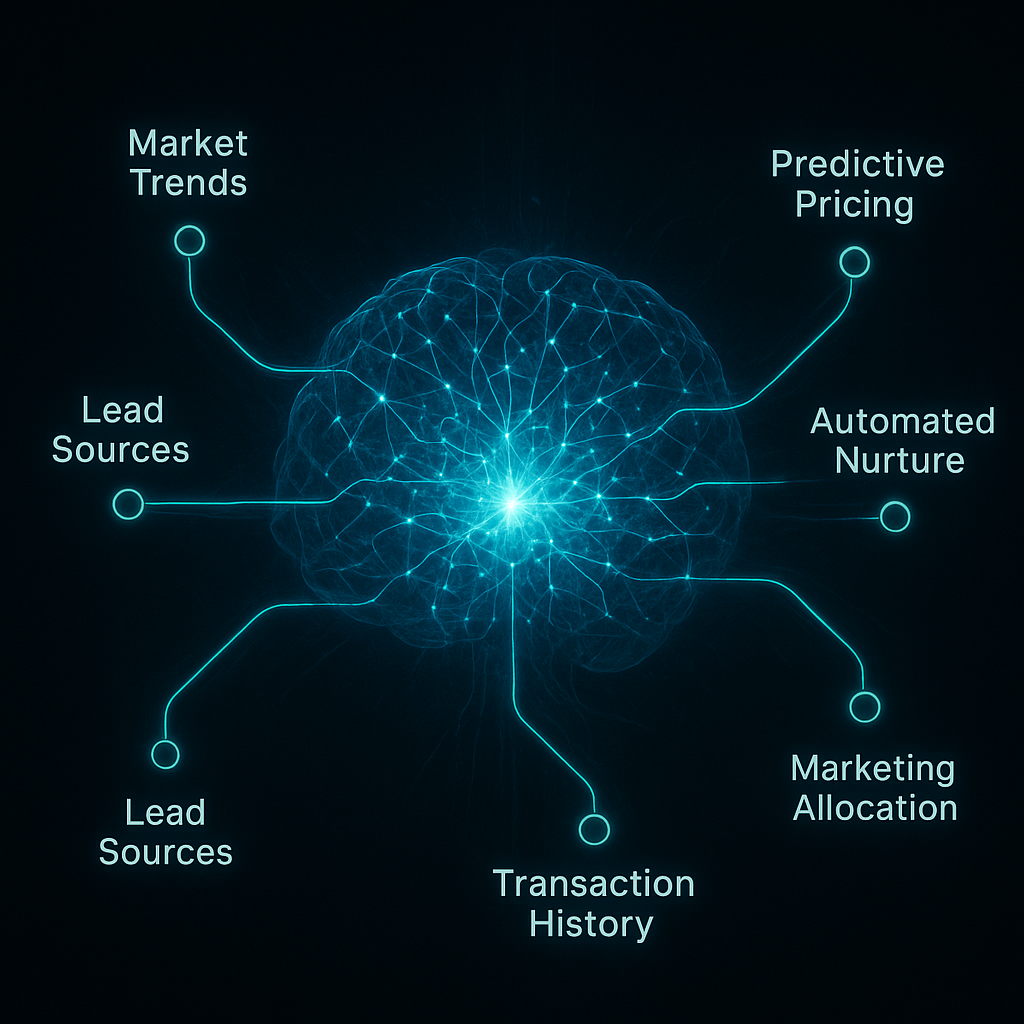
The first is Granular Attribution and Investment Intelligence. For these brokerages, marketing is a pure science of return on investment. The platform's ROI and Source Attribution capabilities go far beyond last click attribution. They employ multi touch models that track a client's entire journey. A leadership dashboard can reveal that a particular Facebook ad campaign was instrumental in raising brand awareness. That campaign might have generated few direct leads, but it led to a twenty two percent increase in direct website traffic and a fifteen percent boost in referral conversions three months later. This allows for sophisticated budget allocation. It considers both immediate lead generation and long term brand building. It treats the marketing budget like a stock portfolio to be constantly rebalanced for maximum yield.
The second is Predictive Pipeline Analytics. Traditional brokerages look at their pipeline as a list of hoped for closings. Algorithmic brokerages view it as a probabilistic model. By analyzing the stage of each deal, the agent involved, the property type, and current market velocity, the system can forecast next quarter's commission revenue with a startling degree of accuracy. It can also identify at risk transactions. These are deals statistically likely to stall. The system can then trigger automated intervention sequences or manager alerts weeks before a human would typically notice a problem.
The third, and most powerful, is the Market Sentiment and Pricing Engine. By aggregating and analyzing data from thousands of buyer inquiries, showing feedback forms, and offer interactions, the brokerage develops a real time pulse on market sentiment. This goes far beyond comparable sales. They can detect that buyer interest in a specific zip code is softening two weeks before price reductions appear in the MLS. They can advise sellers with data backed confidence on not just what price to list at, but what specific features to highlight in marketing based on what similar buyers have valued. They become market makers, not just market followers.
The Human Machine Interface: Augmented Intelligence in Practice
A common fear is that the algorithmic model reduces agents to button pushers. The opposite is true. It transforms them into augmented intelligence operators. The system handles the repetitive computation and data processing. This frees the agent to focus on the complex human elements that algorithms cannot master. These elements include nuanced negotiation, emotional intelligence, and strategic counseling.
The Unified Inbox is the primary interface for this collaboration. It presents the agent with a complete, contextualized view of the client. This view is enriched by the algorithm's insights. Internal notes might be auto tagged with keywords like concerned about school district or motivated by quick close. The agent steps into the conversation fully informed. They are able to provide personalized, high value advice from the very first message.
Automated Workflow and Nurture Systems act as an external memory and executive assistant. The Reactivation Autopilot maintains relationships with past clients through personalized, data triggered communication. This ensures no valuable connection is lost. Transaction pipelines automate the administrative follow ups on inspections and deadlines. This removes the cognitive load of remembering dozens of small tasks. It allows the agent's mental energy to be spent on high stakes advising and problem solving.
This symbiosis is encapsulated in the Mobile App with One Tap Actions. When the system pushes a notification that a high priority lead has replied, the agent is not just told to respond. The app, understanding the context, might surface one tap options like send pre approved lender info, schedule a video tour, or share three comparable listings. The machine provides the optimal next steps. The human provides the judgment and rapport to execute them effectively.
The Leadership Algorithm: Managing by Objective Metric
For the leadership of an algorithmic brokerage, management is no longer a subjective art. It is an objective science driven by dashboards and key performance indicators. The Team Dashboards and Leaderboards provide a real time, unbiased view of organizational health.
Performance is measured not by closed volume alone, but by efficiency metrics. These include lead to appointment conversion rate, average response time, client satisfaction score, and pipeline velocity. These metrics allow for precision coaching. A manager can see that an agent, while closing deals, has a low conversion rate on digital leads. The system can then recommend specific training modules or pair that agent with a top performer in that category. Coaching becomes data driven and constructive. It is focused on improving specific, measurable skills.
Furthermore, the algorithm assists in Resource Allocation and Scalability Modeling. Leadership can run simulations. They can ask, if we hire two new agents specializing in first time buyers and increase our Google Ads budget by five thousand dollars in this geographic area, what is the projected impact on closed commissions in ninety days? This allows for strategic growth that is calculated and confident, not speculative.
Building the Algorithmic Advantage: An Implementation Framework
Transitioning to an algorithmic model requires deliberate action. It is a cultural and operational shift that follows a clear framework.
Phase 1: Data Foundation and Integration. The first step is to break down data silos. This means implementing a central platform that integrates all communication, transaction, and marketing data into a single source of truth. Without this unified data set, no meaningful algorithm can function.
Phase 2: Process Digitization and Automation. Existing manual processes must be mapped and automated. These processes include lead response, scheduling, and follow up nurturing. This creates the consistent, measurable workflows that generate clean, reliable data.
Phase 3: Analytics and Insight Development. With data flowing, the focus shifts from reporting on the past to predicting the future. Teams must be trained to ask new questions. Not how many leads did we get, but which lead sources have the highest lifetime client value? They should ask, what patterns precede a deal falling apart?
Phase 4: Cultural Adoption of Data Driven Decision Making. The final and most critical phase is cultural. It requires leaders to consistently use data in meetings. They must reward agents for adopting systematic best practices, and foster curiosity about what the numbers reveal. The goal is to create a learning organization that gets smarter with every transaction.
The New Competitive Landscape
The rise of the algorithmic brokerage is creating a new competitive hierarchy. At the bottom are brokerages still operating on intuition and manual effort. In the middle are those using piecemeal technology for efficiency. At the top are those who have fully embraced the algorithmic model.
These top performers enjoy formidable advantages. They have lower customer acquisition costs due to hyper efficient marketing. They provide superior client service through predictive personalization. They achieve higher agent productivity and retention by removing friction and providing superior tools. They make better strategic decisions because they are guided by evidence, not opinion.
Most importantly, they build a durable, valuable business. An algorithmic brokerage is a system. Its value is based on its proprietary data, its optimized processes, and its predictive capabilities. These are assets that appreciate over time and are not dependent on any single individual.
Conclusion: The Inevitable Evolution
The transformation to an algorithmic model is not a choice between technology and humanity. It is the intelligent fusion of both. It is about using data and systems to handle what they do best. That includes analysis, pattern recognition, and automation. This allows human professionals to excel at what they do best: empathy, creativity, and complex relationship building.
The brokerages that recognize this are not abandoning the art of real estate. They are perfecting its science. They are building the future of the industry. It is a future where success is not a mystery, but a formula. A formula that is predictable, scalable, and relentlessly optimized. In the 2025 market and beyond, the algorithmic advantage will be the only advantage that matters. The data is no longer just a record of what happened. It is the blueprint for what will happen next. The question for every brokerage leader is no longer whether to embrace this reality, but how quickly they can build their own algorithm.
Frequently Asked Questions
1. How fast can I get set up?

Most solo agents go live in a day using the Real-Estate Snapshot (prebuilt pages, forms, pipelines, and automations). Teams/brokerages typically add routing rules and custom pages and are live within a few days.
2. Can I migrate my contacts and deals from my current CRM?
Yes. Import via CSV in minutes (with field mapping), or use Zapier/Webhooks to pull data from your old system. Our team can help you clean and de-dupe on import.
3. Does Keyvera auto-book showings and listing appointments?
Yep. Share one smart link and Keyvera checks availability, routes by territory/price band/round-robin, sends confirmations & reminders, and provides easy reschedule links to cut no-shows.
4. Where do my leads come into Keyvera from?
Everywhere you work: website chat and forms, SMS, WhatsApp, Facebook/Instagram DMs, Google ads/LSA landing pages, and referral or open-house forms—everything lands in one Unified Inbox and into your pipelines.
5. Does Keyvera replace my website or work with what I have?
Both. You can keep your current site and add Keyvera forms/chat, or launch high-converting property pages and funnels on your own domain with our builder (MLS-style galleries, RSVP/valuation pages, pixels & UTMs).
6. Is there a mobile app?
Yes. Get real-time push alerts for new leads, replies, and bookings—and reply by SMS, call back, add notes, or re-assign with one tap.
7. What about email/SMS deliverability and phone numbers?
Connect your preferred email and messaging providers (e.g., popular email/SMS/WhatsApp providers). We support domain authentication, quiet hours, opt-out handling, and warmed-up sending to protect deliverability.
8. Is Keyvera compliant with texting rules (TCPA, DNC, etc.)?
Keyvera includes tools to help you operate responsibly—opt-in capture, automatic opt-out, quiet hours, and audit trails. Compliance requirements vary by market; your legal team has the final say.
9. Do I keep my data and branding?
Absolutely. Your contacts, messages, pages, and reports are yours—you can export anytime. All pages, emails, links, and calendars carry your logo, colors, and domain.
10. How is pricing structured?
Plans for solo agents, teams, and brokerages—all include unlimited contacts and the core CRM + automations. Add channels/providers as you scale. (We’ll tailor a plan on the demo and show exact pricing.)
Join the Keyvera Agent Playbook
Get free, weekly, plug-and-play templates that book more showings and win more listings—AI text sequences, high-converting page blocks, open-house RSVP flows, and follow-up scripts that get replies.